Artistic Works Blossom at the Guggenheim Abu Dhabi

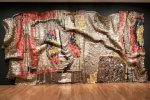
El Anatsui

As the Louvre Abu Dhabi shows off its latest acquisitions in Birth of a Museum, currently on exhibition at Saadiyat Island, the city’s emerging cultural district is also turning its attention to another big name museum due to be erected on its shores. The Guggenheim Abu Dhabi is steadily revealing artworks that its curatorial teams have been acquiring ahead of the museum’s opening in 2017. Early next month [May 6th-8th, 2013], Abu Dhabi Tourism and Culture Authority (ADTCA) brings five major contemporary artists to the capital, all who have works in the new collection, in a bid to introduce the public to the artistic practices of this diverse group.

Read More: Artistic Works Blossom at the Guggenheim Abu Dhabi

China’s Sufis: The Shrines Behind the Dunes

China's Sufis

Lisa Ross’s luminous photographs are not our usual images of Xinjiang. One of China’s most turbulent areas, the huge autonomous region in the country’s northwest was brought under permanent Chinese control only in the mid-twentieth century. Officially, it is populated mostly by non-ethnic Chinese — Turkic peoples like Uighurs (also spelled Uyghurs), Kazakhs, and Kyrgyz, as well as Mongolians and even Russians — and its population has long had difficult relations with Beijing. In 2008, 2009, and 2012, Xinjiang was the site of bloody protests.

Read More: China’s Sufis: The Shrines Behind the Dunes

See also: Living Shrines of Uyghur China

Dargah in Kutch Predates Qutab Minar by 34 Years

A small village in coastal Kutch has the first verifiable piece of Muslim architecture in India that predates the iconic Qutab Minar in Delhi, a Japanese architectural historian said on Friday [April 26th, 2013]. According to the Arabic inscription at Ibrahim dargah in Bhadreshwar, east of Mundra, the structure was constructed in 1159 AD and predates Delhi’s Qutab Minar by 34 years, said Professor Fukami Naoko of Tokyo’s Waseda University, speaking at a lecture organised by the Transindus Foundation.

Read More: Dargah in Kutch Predates Qutab Minar by 34 Years

Archaeology Strains German-Turkish Relations

German-Turkish relations

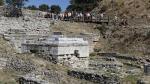
Archaeology often has a lot to do with politics – the current argument between Germany and Turkey is a prime example. Hermann Parzinger, head of the Prussian Cultural Heritage Foundation, last December accused Turkey of displaying “almost chauvinistic behavior.” In reply, the Turkish culture minister Ömer Celik told German news magazine Der Spiegel that he demanded an apology, and he asked for five ancient objects to be returned that are currently shown in museums in Berlin. He claims they were taken out of Turkey illegally. Parzinger rejects any accusations of illegality for three of these objects: In December 2012, he said that the torso of the Fisherman of Aphrodisias, the sarcophagus from the Haci Ibrahim Veli tomb and a 13th-century prayer niche were all acquired legally.

Read More: Archaeology Strains German-Turkish Relations

A Trip Into Baku’s 12th-Century Old City

Baku

In December 2000, the Old City of Baku, including the Palace of the Shirvanshahs and Maiden Tower, became the first location in Azerbaijan to be classified as a world heritage site by UNESCO. It is widely accepted that the Old City, including its Maiden Tower, dates back to the 12th century, with some researchers contending that construction dates as far back as the seventh century. The question has not been completely settled. It was during this period that Baku started to extend beyond the city walls, and new neighborhoods emerged. Thus the terms Inner City and Outer City came into use.

Read More: Photo Essay: A Trip into Baku’s 12th-century Old City

Clarity Vanishes in Big ‘Islamic Art’ Auctions

Islamic auctions London

Jamming into a single auction anything that can be called art from the 7th to the 19th century is not a recipe for coherence. Broaden your geographical sweep to start in Spain and end up in China, and things get worse. You may dub it “Islamic & Indian Art” like Bonhams on Tuesday [April 23rd], or “Arts of the Islamic World” like Sotheby’s on Wednesday [April 24th], but you still won’t gain in clarity.

Read More: Clarity Vanishes in Big ‘Islamic Art’ Auctions

Minaret of Ancient Aleppo Mosque Destroyed

The historic Umayyad mosque in Aleppo without its minaret

The minaret of Aleppo’s ancient Umayyad mosque has been destroyed, Syrian state media and activists say, with the regime and the opposition blaming each other. The mosque, in Aleppo’s UNESCO-listed Old City, has been the centre of fighting for months and had already suffered extensive damage.

Read More: Minaret of Ancient Aleppo Mosque Destroyed

A Remarkable Rediscovery

Saloua Raouda Choucair 5

In 2010, when curators from the Tate Modern in London stepped into the Beirut home of Saloua Raouda Choucair, a Lebanese artist, they were amazed. The house and studio of the woman they would come to call “a pioneer of modernism in the Middle East” was crammed with so many sculptures that some pieces doubled as furniture. Yet hardly any of the hundreds of abstract works, in stone, wood, metal and fiberglass, along with early paintings, had ever been seen in public.

Read More: A Remarkable Rediscovery

See also: A Quest for the Essence

and: Saloua Raouda Choucair: Modernism Off the Map

and: Saloua Raouda Choucair at Tate Modern

Sotheby’s Contemporary Art Doha Sale Achieves $15.2 Million

Sotheby’s Contemporary Art Doha auction achieved the strong total of $15,199,750, solidly between the pre-sale expectations of $11.1/16.1 million, establishing the highest price for an auction of Contemporary Art in the Middle East region. The sale was 89.1% sold by lot. Records were set for nine artists, including a record for a living Arab artist.

Read More: Sotheby’s Contemporary Art Doha Sale Achieves $15.2 Million

World Record at Bonhams for 16th Century Ottoman Masterpiece Once Owned by Bank of England Deputy Governor

Bonhams Iznik bottleBonhams Iznik bottle 2

Two rare Iznik bottles from the golden age of the Ottoman Empire sold at Bonhams Indian and Islamic sale today, April 23rd 2013, for a total of £758,500 – with one making £547,250 a new world record for an Iznnik bottle and the second bottle selling for £301,250. The sale made a total of £3.6m.

Read More: World Record at Bonhams for Ottoman Masterpiece

Istanbul Fairs Aim to Draw Conservative Collectors to Modern Art

All Arts Istanbul 2

The same team determined to put Istanbul onto the international art fair circuit with Contemporary Istanbul (entering its eight edition, 7-10 November) launched a new event designed to deepen the market for traditional Ottoman and Islamic art. The first All Arts Istanbul (April 18th-24th 2013), billed as “a classical and modern art fair”, has the second, more ambitious objective of introducing a new, conservative generation of collectors to modern and contemporary Turkish art.

Read More: Istanbul Fair Aims to Draw Conservative Collectors to Modern Art

Shahnameh of the Digital Age

Shahnameh 3

In his small studio in Brooklyn Heights, New York, Hamid Rahmanian spent 10,000 hours in front of his computer cobbling together a new Shahnameh, the epic mythology of Iran. In the 1,000 years since the Persian poet Ferdowsi put the oral tradition into verse, there have been many versions produced in lithograph, miniature and manuscript form. To create Shahnameh: The Epic of the Persian Kings, Rahmanian meticulously researched and scanned images and texts spanning the 14th through the 19th centuries, from the Indian subcontinent to the Levant and beyond.

Read More: Shahnameh of the Digital Age

See also: Shahnameh Re-Imagined

Photo Essay: Shahnameh for the Digital Age

Video: Shahnameh for the Digital Age Presentation

Stitch in Time

Kalamkari

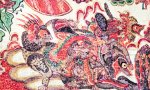
Seventeenth century was a period of transition for India, both politically and economically. While the Mughals strengthened their hold in the north, economic relations were thriving along the Coromandel coast. Merchant guilds flourished across the region, catering to Europeans, exploring far away lands in search of spices and textiles. Besides relishing Indian cloves, Europe was also wearing Indian cotton and soon decorating homes with it. Perhaps it was around this time that a 230 x 180 cm fabric, with kalamkari print, travelled to France.

Read More: Stitch in Time

Pioneer Photographer Deen Dayal Provides a Portrait of India

Deen Dayal

He was not a maharaja — great king — as the major Hindu rulers in British colonial India were called. He was a raja, but one without a kingdom. Deen Dayal, one of the most accomplished photographers of the 19th century, had the title of Raja Mussavir, king of photography. Canadians could call him the Karsh of India, a master of portraiture. Dayal’s photos of British rulers and Indian royalty give us a rare glimpse into a bygone world. The first full-fledged exhibition of his iconic pictures opens at the Royal Ontario Museum Sunday [April 21st, 2013].

Read More: Pioneer Photographer Deen Dayal Provides a Portrait of India

Photo Essay: Rare 19th Century Pictures of India

Doomed Domes

Qutb Shahi Tombs 2

The much talked about restoration plan for the Qutb Shahi tombs seems to hang in balance. Hopes of the domed structures getting a new lease of life look remote, with the A.P. Wakf Tribunal staying the repair work. After years of dilly-dallying, the government signed an MoU on January 9th 2013 with the Agha Khan Trust for Culture (AKTC), the world’s leading conservation body, for restoring the pristine glory of the royal necropolis. But within days of the inking of the agreement in the presence of Chief Minister N. Kiran Kumar Reddy, the whole plan has come unstuck. The AKTC, which is investing Rs. 100 crore to restore the tomb complex, is shocked at the stay on the repair work. “We have never faced such a situation anywhere in the world,” said Ritesh Nanda of the AKTC.

Read More: Doomed Domes

Absence, Disappearance and Loss of Memory in the Work of Twelve Iranian Artists

The Fold

The CAB (Contemporary Arts, Brussels) announces its new exhibition titled ‘The Fold’, which explores, under the curation of Michel Dewilde and Azar Mahmoudian, topics such as absence, disappearance, amnesia and the importance of memory set against the background of modern and contemporary Iran. Inspired by ‘Le Pli’ (1988) of the French Philosopher Gilles Deleuze, the curators choose the fold as the leitmotif for the exhibition. Here, the concept of the fold functions in a variety of modalities including the psychological, historical and political level.

Read More: Exhibition of Iranian Artists at Contemporary Arts, Brussels

The Art of Restoration

When Ratish Nanda, projects director of the Aga Khan Trust for Culture, India, threw open the doors of the newly restored 16th century tomb of Isa Khan on World Heritage Day, visitors and guests took turns to marvel at the ornate ceiling and to applaud Nanda and his team for having restored it beautifully. Everyone except a lady in salwar kameez who seemed to have found the moment too overwhelming and started to cry quietly.

Read More: The Art of Restoration

See also: Heritage is an Educational Legacy

and: Isa Khan Tomb Reopens in New-Found Glory

MOA’s Safar/Voyage Showcases 16 artists from the Middle East

Safar 5

Censorship, restrictive visa requirements and warlike conditions are no match for an artist who has something to say. That’s one of the underlying messages of Museum of Anthropology’s Safar/Voyage: Contemporary Works by Arab, Iranian and Turkish Artists brings together work from 16 artists from the Middle East and opens Saturday, April 20th, 2013. Indeed, those very same conditions can be inspiring. “Art is flourishing in Tehran,” sculptor Parviz Tanavoli said. Tanavoli, who divides his time between Vancouver, Dubai and his native Tehran, is one of the artists in the show.

Read More: Museum of Anthropology’s Safar/Voyage Showcases 16 Artists from the Middle East

See also: Local Artist Parviz Tanavoli’s Bronze Gleams in Safar/Voyage

and: Exhibition in Vancouver Highlights Diversity of the Middle East

Rediscovering the Beauty of Language

Nima Behnoud

New York-based Iranian artist Nima Behnoud’s work is inspired by Persian culture and calligraphy. In his first ever exhibition, Behnoud is showcasing a series of silk-screen prints on paper that feature verses from famous poet Rumi, references to Persian history and mythology, pre-Islamic Iranian motifs, calligraphic letters and Islamic arabesque patterns. But the vivid colours he has used, the way he has juxtaposed the different elements, and his emphasis on geometric forms rather than the meaning of the words gives these artworks a contemporary look.

Read More: Rediscovering the Beauty of Language

Art Sold at Controversial Istanbul Auction Comes Partially to Light

Istanbul auction

When dozens of valuable works by Turkish modern and contemporary artists that had been part of a university museum’s collection were about to be sold at auction earlier this year, an uproar ensued. Petitions were signed and statements of shock were issued against what was perceived as a violation by new American overseers of Istanbul Bilgi University of a sacred trust among museums, donors and the public. Artists and curators feared the sale would amount to a crude stripping of unprotected cultural assets.

Read More: Art Sold at Controversial Istanbul Auction Comes Partially to Light

Heritage is an Educational Legacy

World Heritage Day

April 18th was World Heritage Day. It was an appropriate moment to unveil the restoration of a major Mughal monument in New Delhi, India, the tomb of Isa Khan, within the larger World Heritage site of Humayun’s Tomb. The beautiful octagonal structure is now the centerpiece of a newly restored landscape park. Once dwarfed by the majestic Humayun’s Tomb, which it predates by 20 years, it stands on its own as a new discovery and significant addition to the great monumental heritage of the city.

Read More: Heritage is an Educational Legacy

A Quest for the Essence: Saloua Raouda Choucair’s New Show

Self Portrait, 1943

In Paris in the late 1940s, a publicity-hungry gallerist invited a young, beautiful, unknown Lebanese artist to pose for a photograph alongside Picasso, “before death overtakes him”. Without hesitation, Saloua Raouda Choucair said, “As far as I’m concerned, he’s already dead.” Did she protest too much? Tate’s poster image for the retrospective Saloua Raouda Choucair is a classic post-cubist self-portrait.

Read More: A Quest for the Essence

See also: Saloua Raouda Choucair: Modernism Off the Map

and: Saloua Raouda Choucair at Tate Modern

Local Artist Parviz Tanavoli’s Bronze Gleams in Safar/Voyage

Safar 3

Few of Parviz Tanavoli’s West Vancouver neighbours know that he is one of Iran’s most acclaimed modern artists. When he is not creating monumental bronze sculptures in his Tehran studio or attending exhibition openings in London, Zurich, and Dubai, Tanavoli lives very quietly on a cul-de-sac overlooking Howe Sound. Here, he paints, writes, reads, and works on small-scale sculptures. Perhaps his understated local status will change, however, when Safar/Voyage opens at the UBC Museum of Anthropology this Saturday (April 20th, 2013).

Read More: Local Artist Parviz Tanavoli’s Bronze Gleams in Safar/Voyage

See also: Exhibition in Vancouver Highlights Diversity of the Middle East