Foundation Plans Centre for Heritage Conservation

The Deccan Heritage Foundation (DHF) is planning to set up a restoration centre in Hyderabad to conserve the cultural and architectural heritage of the region. The DHF co-founder Helen Philon told the Times of India on Wednesday that the restoration centre would work in different areas of heritage. “The centre will not restrict itself to saving the architecture alone. There are other historical materials which too have to be saved for posterity. For instance, the proposed centre will have units to preserve paper, timber, metal or any other medium that could be saved,” she said.

Read More: Centre for Heritage Conservation

At the Pinnacle of His Art

Christo sculptureHe is an artist best known for wrapping the Reichstag in Berlin and for siting thousands of coloured umbrellas across valleys in Japan and America. Now the Bulgarian-born American artist, Christo Javacheff, is creating for Abu Dhabi a colossal structure that he claims will be the world’s biggest permanent sculpture. Estimated construction costs of $US340 million ($328m) would also make it the world’s most expensive.

Read More: Pinnacle of Art

Historic Jeddah, Saudi Arabia, Awaits Life-saving Restoration

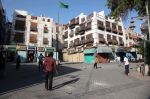
JeddahIn the heart of Saudi Arabia’s sprawling Red Sea port city of Jeddah, centuries-old buildings tilt and buckle above the historic district’s narrow alleys, withering away in the absence of decisive action to protect them. The seventh-century historic district, with its mud and coral town houses adorned with ornate wooden balconies, holds the only remnants of the traditional architecture of the Hijaz, as the western Arabian Peninsula is known. But while Jeddah is building the world’s tallest tower as part of a modernisation drive, efforts to preserve its oldest area are faltering.

Read More: Jeddah Awaits Life-saving Restoration

Seeking a Better Viewpoint to the East

Vanessa Hodgkinson“Where Are You Now?” is a retrospective of young British artist Vanessa Hodgkinson’s work, which reflects different stages of her engagement with Islamic art and the struggle to find her identity in the context of Islamic and Western artistic traditions. The show, curated by Maisa Al Qassimi, traces her artistic journey over the last seven years, while offering a unique Western perspective on the debate about Western perceptions of traditional Islamic art and its relationship to contemporary Western art.

Read More: Seeking a Better Viewpoint

Historic Iraqi Building gets New Lease on Life as Museum

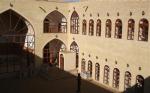
Khan al-ShilanIt served as an Ottoman headquarters, a prison, an ice factory and a mill before falling into neglect. Now, Najaf’s historic and much-loved Khan al-Shilan is getting a new lease on life as a museum. Local authorities in Najaf plan to turn the structure into a museum featuring antiquities and archaeological pieces.

Read More: Iraqi Building gets New Lease on Life as Museum

Al-Mutanabbi Street Starts Here: A Literary Bridge to Baghdad

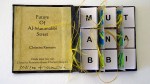
Al-Mutanabbi StreetOn March 5th 2007, at the bloody midpoint of the Iraq war, a car bomb exploded on al-Mutanabbi Street in Baghdad. The attack tore through the heart of the city’s historic literary district, a block crammed with cafés and bookstores. The Shahbandar coffeehouse, a meeting place for generations of Iraqi writers and intellectuals, was blown to pieces; the owner’s four sons and one grandson were killed. Thirty people died and 100 were wounded in the blast, for which no group ever claimed responsibility.

A world away, a San Francisco bookseller read about the attack in his morning paper. Beau Beausoleil, a poet and proprietor of the Great Overland Book Company, a second-hand book store, waited for the outpouring of support and outrage that would surely follow. Nothing happened. Mr Beausoleil felt compelled to act. An attack on writers and booksellers anywhere in the world was an attack on them all.

Read More: Al Mutanabbi Street

Resurrecting the Ottoman Glory of Istanbul?

Istanbul“A new gigantic Sinanesque mosque, the restoration of an Orientalist style barracks building, popularization of ‘1453 conquest’ mentality for Istanbul and of course the insertion of “Golden Horn” metaphor in the shape of a bridge…To make a long story short, all these account to the reinvention of a neo-Ottoman eclectic style,” said Edhem Eldem, history professor at Boğaziçi University. Twenty professors from Boğaziçi University have launched a petition against the environmental damage of Istanbul’s new gigantic construction projects, a campaign that has promptly been signed by at least 224 professors from other universities.

Read More: Resurrecting the Ottoman Glory of Istanbul

A Timeless Hydrological Marvel Allowed to go to Seed

Kundi Bhandara Water WonderThe fear of being lowered 80 feet into the ground by a precarious lift, able to hold one moderately built person at a time, disappears as one intercepts a long underground tunnel whose one end is visible but the other is lost in the labyrinth of curves. The consistently dripping water along the wall of the tunnel and a continuous stream beneath completes the school lessons on hydrological cycle. What one is witness to is the famous Kundi Bhandara, part of the water works system that was established in 1615 AD and which continues to supply water four centuries hence to a population of no less than 50,000 in the city of Burhanpur. One learns that this is one of the last functional systems, of the eight that the Mughal rulers had constructed under the guidance of a Persian geologist, Tabkutul Arz.

Read More: Timeless Hydrological Marvel

Exhibition Highlights the History of Africans in India

Africans in IndiaThere is plenty of historical evidence that Ethiopian traders traveled to India as early as 2,000 years ago. A new exhibition at New York Public Library’s Schomburg Center for Research in Black Culture entitled Africans in India: From Slaves to Generals and Rulers, shows that there was another wave of Africans who arrived in India beginning in the 1100s both as free and enslaved people, among them Ethiopians.

Read More: The History of Africans in India

Sixteenth-century Safavid Carpet to be Offered at Sotheby’s, New York on February 1st, 2013

Safavid carpetIn Safavid Persia, silk was one of the most expensive materials available and, therefore, was reserved for use by the court and the most elite workshops where highly skilled weavers executed designs supplied by court artists. The present carpet, with its complex, layered design of spiraling tendrils terminating in palmettes, was originally in the collection of Edmond de Rothschild (1845-1934), and is estimated at US$500-700,000.

For the catalogue description, see: Safavid Carpet