Artifacts Found in Konya Mosque Attic

Konya Mosque findsMany parts of Qurans, calligraphy that is 200 to 250 years old and two hand-written Qurans have been discovered in the attic of a mosque in the Central Anatolian province of Konya and delivered to the Konya Regional Calligraphy Art Library. The director of the library, Bekir Şahin, said the works had been found by chance during a cleaning of the mosque’s attic.

Read More: Artifacts Found in Konya Mosque Attic

Not a Curve Out of Place

Mosque Design in the WestTo some it resembles a budding flower; others see a spaceport. The building that draws stares in the German city of Cologne is a new mosque, under construction since 2008, and one of a growing crop in countries where a large Muslim presence is new. America’s mosque count rose from 1,209 to 2,106 between 2000 and 2010. In both France and Germany 200 new ones are under way — a 10% increase.

Read More: Architects are Rethinking Mosque Design

Academy Strives to Maintain Classical Pakistani Dance Tradition

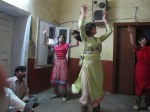
Classical Pakistani DanceIn small groups, the girls begin streaming in to the tiny concrete-walled room that serves as a dance academy. A dozen gangly youngsters plop down on the bare cement floor, chattering incessantly, pulling their hair back into elastic bands, fastening their payal, the cluster of bells braceleting the dancers’ ankles and lower legs. The chatter hushes briefly as the call to prayer rings out from a nearby mosque and the students scramble to cover their heads with their shawls in silent deference.

Read More: Classical Pakistani Dance

The 2012-13 Slade Lectures in Fine Art at the University of Cambridge will be given by Professor Gülru Necipoğlu

Slade Lectures 2013The 2013 Slade Lectures at the Department of History of Art at the University of Cambridge will be given by the Slade Visiting Professor, Dr Gülru Necipoğlu. Dr Necipoğlu is Aga Khan Professor of Islamic Art and Director of the Aga Khan Program of Islamic Architecture at Harvard University. The prestigious Slade Professorship was founded in 1869 as a result of the bequest of the art collector Felix Slade and allows a leading international scholar to deliver an important series of lectures and classes in Cambridge each year. Professor Necipoğlu’s series is entitled ‘Architecture of Empire: The Ottomans, Safavids and Mughals in a Comparative Perspective‘, and the eight lectures will take place on Mondays and Thursdays between February 18th and March 11th, 2013 in the Mill Lane Lecture Rooms at 5.00 pm. They are free and open to all.

Read More: 2013 Slade Lectures at University of Cambridge

Islam at the Louvre

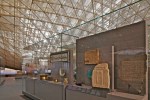
Islam at the LouvreThe roof of the Louvre’s new Islamic art department undulates like golden fabric gently lifted by the wind — a feat, considering it is made of steel and glass and weighs almost 150 tons. Filling a neoclassical courtyard, the addition that opened last fall tripled the space devoted to Islamic art and more than doubled the number of objects on view to almost 3,000, or about a sixth of the museum’s works from the Islamic world.

Read More: Islam at the Louvre

Printmaker Zarina Hashmi Finally Gets Her Due at the Guggenheim

Zarina HashmiZarina Hashmi’s prints and sculptures are as elegantly spare as they are deeply personal, each evoking some element of her long, rich, wayfaring life. They represent the borders she has crossed, the places she has lived, the techniques she has honed, the poetry she has loved, the discipline with which she works, and, above all, a long-standing relationship with her medium of choice: paper, the handmade sort, be it pressed into sheets or extracted raw from vats of pulp. She has pierced it with pinholes; embossed it with thread; sculpted it into geometric bas-reliefs; and imprinted it with maps, lines, shapes, Urdu script, and the dense, sinewy grain of unsanded planks of wood. The breadth of her output will be on display in a long-overdue retrospective, Zarina: Paper Like Skin, opening January 25th, 2013 at the Guggenheim Museum in New York.

Read More: Zarina Hashmi at the Guggenheim
The Battle Within

Ahmad Ameen NazarWell-known Iranian artist Ahmad Ameen Nazar’s paintings are usually inspired by heroes and demons from Persian mythology or the dramatic stories of kings and warriors of the Qajar dynasty. But his latest body of work, titled “Salto”, is quite different. It is a series of large drawings on paper depicting wrestlers grappling with each other. The artist has used ink and diluted acrylic paints to impart a sepia tone to the drawings, which have the look and feel of renaissance-style figurative studies.

Read More: Ahmad Ameen Nazar

Light from the Middle East

Light from the Middle East 2From 9/11 to the Arab Springs, media coverage has become increasingly dominated by the Middle East in recent years. At the moment, as reports emerge of the kidnappings and deaths of foreign nationals in Algeria, we are again met with an image which has become par for course: the bearded jihadi fundamentalist facing the camera. Meanwhile, the wealth of footage documenting the uprisings in the Maghreb presents the region as one of constant turbulence and violence. There is a danger of reducing the Arab world to tired caricatures – or in the words of the late Edward Said (the main theorist on post-colonialism) a depiction of Arabs as ‘either oil suppliers or potential terrorists’. The current exhibition at the Victoria & Albert Museum, Light from the Middle East does not allow for any such crude taxonomy. The first major museum exhibition of Middle Eastern photography, it spans a huge scope of different work produced by artists from across the region, ranging from North Africa to Central Asia.

Read More: Light from the Middle East

Infinity and Accident: Strategies of Enfoldment in Islamic Art and Computer Art

ArtsIslamicaacademic-sComputer art and Islamic art, the two largest bodies of aniconic art, share a surprising number of formal properties, two of which are explored by Laura M. Marks in this paper published in 2006. The common properties of computer art and classical Islamic art can be understood in light of moments in the history of Islamic philosophy. In these two cases, Islamic Neoplatonism and Mu’tazili atomism are shown to parallel, respectively, the logic of relations between one and infinity, and the basic pixel structure, that inform some historical monuments of Islamic art as well as some contemporary works of computer art. It is suggested that these parallels are in part a result of Islamic influences on Western modernism and thus that the genealogy of computer art includes classical Islamic art and the philosophies that informed it.

Read More: Infinity and Accident, by Laura M. Marks

Experiencing the New Galleries of Islamic Art at the Louvre

Islamic Gallery LouvreIn September 2012, the Louvre Museum in Paris opened a new wing dedicated to the arts of Islam. The new extension, in the neo-classical, 19th century Visconti courtyard of the Louvre, has an undulating glass and metal roof, under which is displayed the largest and most significant collection of Islamic art in Europe. In this article, Daniel Waugh of the University of Washington, Seattle, provides some first impressions, as well as reviews the catalogue published in conjunction with the opening of the new galleries.

Read: Arts of the Islamic World in the Louvre

On the Magic Carpet of the Met

Islamic collection at MetropolitanOn November 1st, 2011, the the New Galleries for the Art of the Arab Lands, Turkey, Iran, Central Asia, and Later South Asia at the Metropolitan Museum of Art in New York opened. Eight years in the making and arranged across fifteen rooms, these galleries showcase some 1,200 artworks, including exceptional examples of manuscripts, textiles, glass, ceramics, jewellery, armour, painting, scientific instruments, wood stone and ivory, from one of the most important collections of Islamic art outside the Middle East. In this insightful essay, published in December 2011, Peter Brown reviews the galleries and the accompanying catalogue.

Read More: On the Magic Carpet of the Met

Questioning Modernity with An Exhibition

Modernity exhibition in IstanbulIstanbul Modern’s new exhibition Modernity? Perspectives from France and Turkey explores the effects of modernity on contemporary art. Sponsored by the Comité Colbert, the show will be on view until May 16th 2013, focusing on how artists have come to a reckoning with the phenomenon of modernity, a concept that is still valid today.

Read More: Questioning Modernity

Love and Devotion: From Persia and Beyond

Love and Devotion BodleianFeaturing more than sixty rare examples of 13th- to 18th- century Persian, Mughal Indian and Ottoman Turkish illustrated manuscripts from the Bodleian Library’s collection, Love and Devotion: From Persia and Beyond, celebrates the beauty of these texts, and the stories of human and divine love they tell. These magnificently illustrated works come from one of the richest periods in the history of the book and give a fascinating insight into the great artistic and literary culture of Persia and its timeless stories. The exhibition is at the Bodleian Library until April 28th, 2013.

Read More: Love and Devotion at the Bodleian Library

French-Moroccan Artist Bouchra Khalili Maps the Migrant Experience

Bouchra KhaliliFilmed through a door’s glass panels, a young woman speaks in Arabic. “A civilization that proves incapable of solving the problems it creates is a decadent civilization,” read the subtitles. “A civilization that chooses to close its eyes to its most crucial problems is a stricken civilization. A civilization that uses its principles for trickery and deceit is a dying civilization.” The woman appears to be musing on the world’s current state of affairs; perhaps she’s being filmed in Europe, or in North Africa.

Read More: Bouchra Khalili

Archaeological Heritage of Syria in Danger

A report by the Syrian Historical Heritage Under Threat, an international non-governmental organization, lists 12 museums throughout Syria, including the museum in Maarat al-Nu’man, that are under threat. The same report lists 24 archaeological sites, 11 centuries-old fortresses, 14 historical mosques, five ancient churches and four historical districts threatened by a combination of aerial bombings, illegal excavations, looting, vandalism, illicit trafficking of cultural property and the installation of heavy weapons.

Read More: Archaeological Heritage of Syria in Danger

Syria’s Looted Past: How Ancient Artifacts Are Being Traded for Guns

Syria's Looted PastAbu Khaled knows the worth of things. As a small-time smuggler living along the porous border between Syria and Lebanon, he has dabbled in antiquities as much as the cigarettes, stolen goods and weapons that make up the bulk of his trade. So when a smuggler from Syria brought him a small, alabaster statue of a seated man, he figured that the carving, most likely looted from one of Syria’s two dozen heritage museums or one of its hundreds of archaeological sites, could be worth a couple thousand dollars in Lebanon’s antiquities black market.

Read More: Syria’s Looted Past