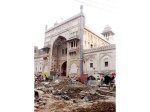
The Walled City of Lahore Authority (WCLA) has started testing a new geographical information system (GIS) to help it regulate conservation and development work at the city’s historic quarter.
Read More: Walled City of Lahore
07 Sunday Jul 2013
The Walled City of Lahore Authority (WCLA) has started testing a new geographical information system (GIS) to help it regulate conservation and development work at the city’s historic quarter.
Read More: Walled City of Lahore
06 Saturday Jul 2013
Posted in Islamic Art - Essays
A place is undoubtedly emerging for Islamic material culture within the medieval Mediterranean framework: there is even a sub-discipline that has been styled the ‘Islamic Mediterranean’. This essay will not attempt a detailed historiographical review of all the recent academic output on this region, which is – suddenly – vast, but will offer some reflections on the ‘nascent field’ of what is becoming known as ‘Mediterraneanism’; next, it will examine some of the problems that still remain for the study of Islamic material culture in the Mediterranean, and suggest some ways forward.
Read More: Mediterraneanism: How to Incorporate Islamic Art into an Emerging Field, by Mariam Rosser-Owen
05 Friday Jul 2013
Posted in Islamic Art - Essays, Scholars - United States
It is safe to say that the flood of reminiscences, obituaries, and various kinds of public necrologies that have marked the death of Oleg Grabar are quite without parallel in the history of Islamic art history. They complement the numerous appreciations of him that were published in his lifetime, and indeed his own reflections on his career. In the months following his death in January 2011 a series of meetings was convened at which scholars spoke about his work, and the anniversary of his death was marked by a symposium in Istanbul to celebrate his contributions to the understanding of Turkish Islamic art. Other great figures in the field of Islamic art have had their full meed of honour, with memorial services and colloquia, and tributes from the great and the good, as well as obituaries not only in academic journals, where one would expect to find them, but also in broadsheets. But the reaction to Oleg Grabar’s death has been at once more widespread and more profound than this. The sense that an era has ended runs through many of the comments made in both public and private. The obvious question – ‘why?’ – does not have a single obvious answer. It has several, and at times they may seem to contradict each other.
Read More: Oleg Grabar: The Scholarly Legacy, by Robert Hillenbrand
04 Thursday Jul 2013
Posted in Islamic Art - Essays
Despite well-meaning and well-informed scholarly and museological intentions, Islamic art history has had limited success as a good ambassador for Islam. Rather than suggesting that it should not be expected to take on this public role and cannot responsibly make such an attempt, or that the problem should be avoided by jettisoning the term ‘Islam’ from the name ‘Islamic art history’, this paper proposes the following. First, in order to function as a critical humanistic discipline, Islamic art history must engage in a self-conscious critique of the historiographic problems of its nomenclature in relation to its own sociopolitical contexts. Second, the field should, wholeheartedly and with critical self-awareness, take on the public and political role that has been foisted upon it by sociopolitical imperatives that will be discussed below.
Read More: The Islam in Islamic Art History: Secularism and Public Discourse, by Wendy M. K. Shaw
03 Wednesday Jul 2013
Posted in Islamic Art - Essays
Regions and fields that can bring together state sponsorship, industry partners, science computing experience and resources will be at the forefront of a digital shift that reflects the world’s hierarchy of advanced industrialized nation-states and economies and their priorities. Already graduate students and researchers working in select fields can conduct large amounts of their research remotely and digitally, reducing costs for travel and archival work. Colleagues in humanities disciplines and fields of art history that successfully embark on the digital shift will be able to effortlessly scan through thousands of primary texts and images across centuries, perform statistical analyses on large pools of data, visualize complex relationships and correlations with geography and generate new genres of scholarship. Without a critical mass of systematically developed databases of historical texts, translations, and images with rigorous data quality controls and overlaying analytical tools, the way Islamic art history will be written will increasingly diverge from those fields of art history that embrace the digital shift more fully. This paper makes the case that the historiographical challenge which Islamic art historians face is not simply to consider and apply new theoretical frameworks, but to scrutinize and participate in the design and development of scholarly digital infrastructures, databases and analytical instruments specifically geared to the interests of Islamic art historians, while confronting the field’s archival legacies.
Read More: Towards Digital Islamic Art History, by Hussein Keshani
22 Saturday Jun 2013
Posted in Heritage Sites - India
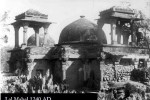
From the narrow lanes of Delhi’s impoverished Nizamuddin Basti area, it’s almost impossible to see the ”Lal Mahal”, or the Red Palace, which is one of India’s earliest Islamic royal dwellings. In many cities, endowed with a lesser bounty of historic buildings, the Lal Mahal may have become a tourist draw. It was constructed in the mid-13th century of red sandstone by one of Delhi’s first sultans, a slave dynasty of Turkic origin that brought Islam to the region.
Read More: In Delhi, Developers Imperil Islamic Palace
22 Saturday Jun 2013
Posted in Museums - North America
After a yearlong search, the San Diego Museum of Art has named Marika Sardar its new associate curator of Southern Asian and Islamic art. A senior research associate at New York’s Metropolitan Museum of Art and a specialist in Islamic art, Sardar is a graduate of New York University’s Institute of Fine Arts and Rice University.
Read More: SDMA Appoints Marika Sardar
12 Wednesday Jun 2013
Posted in Auctions - France
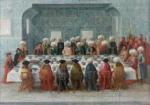
An important and rare oil painting depicting the reception given in 1625 by Gabriel Bethlen, Prince of Transylvania, in honour of the Ottoman ambassador Yusuf Agha Mouttaher at Castle Gyulafehérvár (now Alba Iulia in Romania), sold for Euros 260,000 at Pierre Berge, Paris, on Monday [June 10th, 2013].
Read More: 17th-century Painting of Ottoman Diplomatic Mission Sells for Euros 260,000
12 Wednesday Jun 2013
Posted in Exhibitions - Middle East

Even if you don’t understand the letters, you can appreciate the beauty of Arabic calligraphy. It has been studied and developed for centuries and the dimensions of the letters are based on the golden ratio. “Calligraphy opens the door to aesthetic values that are not available in nature,” says Majid Al Youssef, one of 12 calligraphers whose works are on show at Ara Gallery in Downtown Dubai.
Read More: Dubai Islamic Art Exhibition Gives Calligraphy a Contemporary Twist
07 Friday Jun 2013
Posted in Exhibitions - Europe - Denmark

At around the midway point in my tour of the David Collection, I have lost all sense of time and, to a certain extent, space. This is partly due to the museum’s contents – a mesmerising array of Islamic art from several centuries and continents, in a very modern setting – but also its bewildering size.
Read More: Danish Exhibition Explores Images of Nature in Muslim Art
07 Friday Jun 2013
Posted in Exhibitions - North America

Back in the 20th century, everyone was talking about how New York had wrested the status of modern-art capital from Paris. Nowadays, curators in the U.S. and Europe are vying to share the spotlight.
Read More: The Other Modernism
06 Thursday Jun 2013
Posted in Auctions - North America
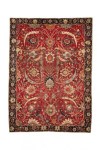
A Persian carpet decorated with swirling vines and vibrant flowers that was stored for decades by the Corcoran Gallery of Art sold Wednesday [June 5th, 2013] for more than $30 million. That sum, fetched at a Sotheby’s sale, shattered the previous record for rugs sold at auction. But it won’t help the struggling Washington gallery overcome its financial woes because the money must be used for future acquisitions, not to help the bottom line.
Read More: Clark Sickle-Leaf Carpet Breaks World Record at Sotheby’s
See also: The Clark Sickle-Leaf Carpet Sets a New World Record at Sotheby’s
05 Wednesday Jun 2013
Posted in Auctions - North America

One of the most beautiful and famous Safavid carpets, and one of the outstanding examples of Persian carpet weaving from the first half of the 17th century — the Clark Sickle-Leaf Carpet — sold for US$33.765 million at Sotheby’s, New York, today [June 5th, 2013].
Read More: The Clark Sickle-Leaf Carpet Sets a New World Record at Sotheby’s
See also: The Clark Sickle-Leaf Carpet
See Video: The Clark Sickle-Leaf Carpet (Video)
04 Tuesday Jun 2013
Posted in Exhibitions - North America

Past and present come together seamlessly in Soody Sharifi’s collages. Still, something seems off. In “Fashion Week,” contemporary women who have been digitally dropped into an ancient Persian court scene strut a catwalk that leads to an empty throne. Modestly dressed in street clothes, the ersatz models’ heads are covered by hijabs of varying lengths. Meanwhile, their precursors enjoy the show free of head scarves.
Read More: Inspired by Islam
01 Saturday Jun 2013
Posted in Architecture - Pakistan
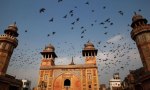
Mohammed Jahangir can remember when his friends ran through the streets of the famous Walled City of Lahore, racing past the mosques and through the markets. Then came long decades when even walking through its streets, choked by illegal construction, was hard. Now, a pioneering new restoration project has allowed the 80-year-old to glimpse once more the city of his childhood.
Read More: Walled City of Lahore
01 Saturday Jun 2013
Storytelling has been an integral part of life in the Middle East — and Iran in particular — for centuries. Whether spoken in the streets, played as a game or painted on a canvas, Iranian folkloric tradition, with its uniquely theatrical and magical approach to the question of what it means to be a denizen of the earth, traverses regions and generations. Fairy tales, jokes, religious allegories, and animal legends have long been a part of a continuing oral and visual history, though the number of Naghals (traditional Persian storytellers who narrate painted scenes) has dwindled in recent decades. Still, elaborate storytelling in all forms remains ubiquitous, and to be Iranian means having the ability to suspend one’s disbelief and succumb to the sometimes troubling, sometimes beautiful details of an oft-told tale.
Read More: Farideh Lashai
31 Friday May 2013
Posted in Museums - Middle East - Qatar

The Qatar Museums Authority, led by HE Sheikha Al Mayassa Bint Hamad Bin Khalifa Al Thani, is delighted to announce the appointment of Dr Abdellah Karroum as the new director of Mathaf: Arab Museum of Modern Art. Karroum, a curator, researcher and independent artistic director, will assume his new role at Mathaf in June 2013.
Read More: Mathaf Arab Museum of Modern Art Announces Dr Abdellah Karroum as Director
29 Wednesday May 2013
Posted in Heritage Sites - Egypt
Representatives of an Egyptian heritage body have called for authorities to act to stop ongoing building and painting work at the Sayyeda Zeinab Mosque in Cairo. On Monday [May 20, 2013], Samir Gharib, head of the National Organisation for Urban Harmony (NOUH) called on Cairo governor Osama Kamel to stop the work on the façade of the Sayyeda Zeinab Mosque in downtown Cairo because it does not follow the established regulations for the protection of historic buildings.
Read More: Sayyeda Zeinab Mosque
29 Wednesday May 2013
Posted in Exhibitions - United Kingdom

During the run of Light From the Middle East, the much-heralded photography show at London’s V&A last year, the Syrian photographer Issa Touma was asked if he thought of his work as political. His answer was telling. “Everything in the Middle East can be political if you have censorship,” he said of his homeland and the harassment he has faced from the Assad regime. “They do not like the freedom I have, but they also do not have much choice. I exist in some way.”
Read More: Arab Identity in Political, Funny and Unforeseen Forms on Show in Liverpool
29 Wednesday May 2013
Posted in Exhibitions - Middle East

A mercury vision captured on a copper plate of the iridescent figure of Ayoucha, the earliest known photographic depiction of a veiled woman from the Islamic world, flickers between being and nothingness, between a positive and a negative image, as light reflects off the silvered surface of the 170-year-old daguerreotype.
Read More: The Orient, Expressed in Abu Dhabi
22 Wednesday May 2013
Posted in Heritage Sites - India
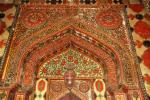
Intricate paintings done over 600 years ago inside the tomb of Sufi saint Syed Shaha Qhabululla Husayni, at the dargah of Sufi saint Khwaja Bandanawaz Geusdaraz, could soon be replaced with glasswork.
22 Wednesday May 2013
Posted in Photography - Middle East

This article had its start in a dusty, little antiques store in Haifa. It was there, next to a folded and stained marriage certificate (Tel Aviv, 1931), and underneath photo albums of family and travels in the Land of Israel (1935) that a greenish paper wrapper peeked out, inside which were eight picture postcards of Cairo, in black and white. On the wrapper were printed the name and address of an emporium, in Arabic and English: Lehnert & Landrock, 44 Sherif Pasha Street, Cairo, Egypt. I bought them. When were the pictures taken? And who was the photographer? I set out in search of the answers.
21 Tuesday May 2013
Posted in Heritage Sites - India
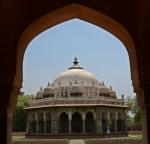
“For conservation to be successful in our country it is necessary that we return to a craft-based approach where master craftsmen are empowered to match the work of their forefathers using traditional materials, tools and building craft traditions,” said Aga Khan Trust for Culture project director Ratish Nanda, who has been associated with the restoration work of the two Mughal era garden tombs of Isa Khan Niyazi and Bu Halima over the past two years.
Read More: Mughal Era Tombs Restored to Their Traditional Grandeur
21 Tuesday May 2013
Posted in Archaeology - Indonesia
Ruins of the 17th Century Islamic Mataram Kingdom as well as pottery fragments have been found in Kedaton village in Pleret, Bantul regency, Yogyakarta, by the provincial cultural agency excavation team. “The ruins are still intact. In the past, we have only found parts or pieces of such artifacts,” field coordinator Rully Andriadi told The Jakarta Post.
Read More: Mataram Kingdom Ruins Found in Bantul
20 Monday May 2013

The roof garden at the Metropolitan Museum of Art is one of the lovelier places to go in New York during the warm seasons. Every year its pastoral bliss high above Central Park is complemented by some sort of benign sculpture exhibition, usually three-dimensional works of formal decorum or playful ingenuity. This year visitors will discover something strikingly different: the 8,000-square-foot terrace is splattered with paint the color of dried blood. At first glance it looks like a crime scene or the site of a ritual slaughter.
Read More: The Roof Garden Commission: Imran Qureshi at the Met
 ArtsIslamica